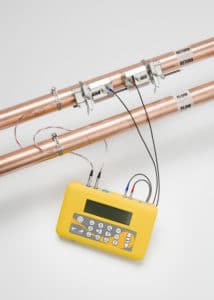
Hazardous area flow measurement can create a difficult engineering decision. A site may need a fixed and reliable flow measurement point, but installing an inline wetted meter can involve cutting into pipework, adding flanged connections, arranging shutdowns and introducing additional engineering work.
For compatible liquid duties, non-invasive clamp-on ultrasonic measurement offers a different approach. By measuring from outside the pipe, the technology can help customers avoid intrusive pipework modification while still gaining the flow measurement data they need.
The Micronics UX5000 is a fixed ATEX Zone 1 ultrasonic clamp-on flow meter for classified-area liquid flow applications. It is particularly relevant where customers need permanent measurement, but want to avoid unnecessary process intrusion, additional wetted connections or new potential leak paths.
Micronics and Able Instruments & Controls Ltd work together to support customers with the UX5000. Micronics brings British manufacturing capability and product expertise. Able brings application knowledge, hazardous area experience and field support, built on more than 40 years of specifying, installing and maintaining clamp-on ultrasonic flow meters in demanding industrial environments.
In this interview, James Charlton, Head of Sales and Service at Micronics, and Simon Smith, Head of Sales at Able Instruments, discuss why non-invasive ATEX flow measurement matters, where the UX5000 fits, why no single flow technology suits every application, and how customers can avoid unnecessary over-engineering when selecting a hazardous area flow meter.
Why does non-invasive flow measurement matter in hazardous area applications?
James Charlton, Micronics:
Non-invasive flow measurement matters in hazardous area applications because it can provide flow data without cutting into the pipework. If a customer installs an inline wetted flow meter, they may need to breach the pipework, introduce flanged connections and carry out a more involved engineering installation.
That can add significant engineering cost and installation work. It can also introduce additional potential leak paths, which many customers will naturally want to avoid where a compatible non-invasive measurement option exists.
The value of clamp-on ultrasonic technology is that the transducers are mounted externally. In the right application, that allows the customer to measure flow without cutting into the pipe or interrupting the process in the same way as an intrusive installation.
Simon Smith, Able Instruments:
Customers often consider clamp-on technology when they need a fixed measurement point but want to avoid unnecessary modification to existing pipework.
For hazardous area sites, avoiding unnecessary intrusion into the process can be a major advantage. It can reduce installation work, support safer project planning and help customers achieve the required flow measurement with less disruption.
Where does the Micronics UX5000 fit?
James Charlton, Micronics:
The UX5000 fits fixed hazardous area liquid applications where non-invasive ultrasonic flow measurement is technically appropriate. It is best considered where a permanent measurement point is required and where external clamp-on installation is beneficial.
Typical applications may include hazardous area process lines, chemical and petrochemical sites, utilities, power-related duties and industrial water applications where the pipework and liquid conditions support ultrasonic measurement.
The important point is that suitability should be reviewed properly. Pipe material, pipe size, liquid type, temperature, available straight pipe run and the presence of gas bubbles or solids can all affect the measurement approach.
Simon Smith, Able Instruments:
For Able, the UX5000 provides a practical fixed ATEX clamp-on option within a wider flow measurement portfolio. It gives customers an option where hazardous area approval, non-invasive installation and practical deployment are all important.
It is especially relevant where the customer wants to add measurement to an existing line, avoid process disruption or assess a fixed measurement point without immediately moving towards a more intrusive installation.
Is clamp-on ultrasonic measurement always the right answer?
James Charlton, Micronics:
No single flow measurement technology is right for every application. Clamp-on ultrasonic measurement can be a very effective solution, but it should not be treated as a one-size-fits-all answer.
There will be applications where Coriolis, differential pressure or another flow technology is more appropriate. That may be because of the liquid, the process conditions, the accuracy requirement, the installation environment or the customer’s wider measurement objective.
The key is to review the application properly before selecting the instrument.
Simon Smith, Able Instruments:
That is a very important point. Able has a broad flow measurement portfolio, so our role is not to force every enquiry towards one product or one technology.
Our reputation has been built on helping customers apply the right tool for the job. Sometimes that may be clamp-on ultrasonic technology. Sometimes it may be Coriolis, DP, thermal, electromagnetic or another flow measurement approach.
The UX5000 gives us a strong ATEX clamp-on option, but the customer still benefits from an application-led discussion before the final selection is made.
Do customers sometimes default to over-engineered flow measurement solutions?
James Charlton, Micronics:
Yes, some customers default to familiar high-end flow measurement solutions because those systems have been used before or have become the standard choice within a site, project team or procurement process.
That does not necessarily mean the existing approach is wrong. However, it can mean customers are selecting a system with a level of specification that the application does not always require.
A more pragmatic approach is to start with the actual duty. What certification is required? What liquid is being measured? What accuracy and outputs are needed? What is the installation environment? What level of engineering work is justified by the application?
For many fixed hazardous area liquid flow applications, the UX5000 can provide a technically and economically appropriate solution without adding specification that the duty does not require. With clamp-on technology, the commercial discussion is also not driven in the same way as an inline meter installation, where pipe size, flanges and associated mechanical work can materially affect the overall project cost. This can make a pragmatic clamp-on solution attractive across a range of pipe sizes, subject to the final configuration.
Simon Smith, Able Instruments:
Appropriate specification depends on both the technical requirement and the commercial context. The highest specification option is not automatically the best choice for every application.
Some applications genuinely need a very high-specification system. Others need a robust, compliant and practical hazardous area clamp-on meter that meets the requirement without being over-engineered.
Able’s role is to help customers understand that distinction. We can look at the process, the hazardous area requirement, the measurement objective, the installation constraints and the wider project context before recommending the right route.
How does the Micronics and Able relationship support customers?
Simon Smith, Able Instruments:
The Micronics and Able relationship supports customers by combining manufacturer expertise with long-standing field and application experience. Able’s involvement with clamp-on ultrasonics goes back to the early use of the technology in heavy industry and offshore oil and gas. In fact, Able’s founder supplied and commissioned the first clamp-on ultrasonic flow meter deployed on an offshore North Sea platform in the early 1990s.
That history matters because clamp-on measurement has always been application-led. The technology can offer significant installation advantages, but only when the pipework, liquid conditions and measurement objective are properly understood.
With the UX5000, Able can combine that field experience with Micronics’ product expertise to help customers assess whether the instrument is the right fit for their application.
James Charlton, Micronics:
The relationship works because Micronics and Able bring complementary strengths to the same customer requirement. Micronics provides the manufacturing capability, product knowledge and technical understanding of the UX5000. Able brings application experience, field expertise and direct customer support.
Both companies are British businesses, and that is relevant because customers often value clear communication, practical support and close technical collaboration when they are specifying equipment for hazardous area applications.
Working with Able gives customers access to a partner that understands not only the product, but also the type of application where the product is likely to be considered. That shared understanding is an important part of the trust behind the relationship between both parties.
What does Able’s wider UX5000 support role mean for customers?
James Charlton, Micronics:
Able’s wider UX5000 support role helps customers access hazardous area application expertise beyond the UK and Ireland where Micronics’ international network requires that support.
Further to Able’s exclusive UK and Ireland representation for Micronics, Micronics operates in more than 90 countries globally, and Able’s specialist hazardous area expertise means they are well placed to support UX5000 opportunities across these locations.
Simon Smith, Able Instruments:
The main customer benefit is earlier access to informed UX5000 application guidance. That includes confirming the application, understanding the hazardous area requirements and making sure the proposed solution is appropriate before the customer commits.
Wherever the enquiry originates, the important thing is that the customer receives the right technical guidance and that the application is assessed properly before a recommendation is made.
What information should customers provide before specifying an ATEX clamp-on flow meter?
Simon Smith, Able Instruments:
Customers should provide enough application information to confirm whether ATEX clamp-on ultrasonic measurement is appropriate. At a minimum, we would normally want to understand the pipe size, pipe material, wall thickness, liquid type, flow range, process temperature, hazardous area classification, available straight pipe run and required outputs.
It is also useful to understand why the measurement is needed. A customer verifying an existing process line may have different priorities from a customer adding a permanent monitoring point into a project package.
James Charlton, Micronics:
Installation conditions matter because ultrasonic measurement depends on reliable signal transmission through the pipe and liquid. Correct transducer placement, suitable pipe condition and stable installation all contribute to reliable measurement.
Where the application is suitable, clamp-on ultrasonic measurement can be a very effective solution. Where the liquid contains significant gas bubbles, solids or aeration, the application may need closer review, or a different ultrasonic technology may be more appropriate.
What is the key takeaway for engineers?
ATEX flow measurement does not always need to begin with breaching the pipework. In suitable liquid applications, a fixed clamp-on ultrasonic system such as the Micronics UX5000 can provide a practical route to hazardous area flow measurement without intrusive pipe modification.
The key is application suitability. Customers should consider the process conditions, pipework, hazardous area classification, measurement objective, required specification and documentation requirements before selecting a system.
The UX5000 should not be viewed as a one-size-fits-all answer or simply as an alternative to higher-specification systems. It should be viewed as a pragmatic fixed ATEX clamp-on ultrasonic option for suitable liquid applications where non-invasive installation, appropriate specification and application-led support matter.
Micronics and Able Instruments work together to help customers assess those factors and identify whether the UX5000 is the right approach for their application.
Next steps
Customers considering fixed ATEX clamp-on ultrasonic flow measurement can view the Micronics UX5000 product information, technical specification and downloads, or explore the wider range of hazardous area flow meters available from Micronics.
For application guidance, specification support and quotation assistance through Able Instruments, customers can also review the Micronics UX5000 ATEX Zone 1 clamp-on flow meter on the Able Instruments website.
Email: info@ableinstruments.com
Telephone: +44 (0) 118 931 1188